
Finding Fountain Hills Residents
A useful Fountain Hills residents directory starts with the clue already in hand. A street address points to the Maricopa County Assessor, while an owner name can lead from the assessor parcel to a recorded deed. A case number belongs with the court that created the file. Older names call for regional directories, newspapers, census releases, and county land records because Fountain Hills incorporated in 1989. Write down the source date and the exact role shown. An owner, deed party, voter, permit applicant, and directory householder are not the same thing.
Official rolls are narrow by design. Property records omit most renters and other household members. Voter material excludes protected voters and cannot reveal a ballot choice. Court indexes omit confidential files. A missing result is therefore a gap, not proof that a person never lived in Fountain Hills. Work from the strongest identifier, such as an APN, legal description, case number, or license number, then compare two independent records.
- Search the county property roll by full address, owner, APN, subdivision, city, or ZIP.
- Copy the parcel's deed number and legal description before opening the Recorder index.
- Use a lawful voter or court channel only when it answers a specific identity question.
- Move to regional directories, yearbooks, newspapers, or released census records for past residents.
- Request a named record series, date range, and format when no public portal supplies it.
Fountain Hills Records Custodians
Fountain Hills is a town in Maricopa County, so no single municipal desk holds the full resident trail. The Town Clerk keeps council, planning, permit, code, election, and administrative material. County offices keep ownership, deeds, voter files, taxes, and Superior Court records. State offices control archival vital records, professional licenses, and statewide court finding aids. Phone or counter help is useful when an index fails, but ask about procedure, retention, and a known document rather than expecting staff to research a person.
Maricopa County Recorder
301 W Jefferson Street, Suite 200
Phoenix, AZ
602-506-3535
Maricopa County Assessor
Property ownership and parcels
Phoenix, AZ
County inquiry channel
Recorder and Elections
Registration files and requests
Maricopa County, AZ
Purpose-limited access
Town Hall is the local municipal stop. The county offices are the property, deed, voter, and Superior Court stops, even when the subject address is inside Fountain Hills. Each linked portal has a mail, counter, form, or copy channel for records that are missing online.
Fountain Hills Property Records
The Maricopa County Assessor Property Search is the fastest official name-to-address lead for Fountain Hills. It accepts more than a street address. Search by owner, APN, subdivision or MCR, city, ZIP, section-township-range, business account, or mobile-home details. The result can show the situs address, owner mailing address, deed number and date, legal description, parcel use, values, improvements, and map links.
Situs means the taxable land's physical location. Mailing address means where tax correspondence goes. A match between them supports possible owner occupancy, but it does not identify every resident. Parcel splits or combinations can also break a current APN trail. Ask the Assessor for a parcel-history report when an older identifier disappears.
| Search mode | Format clue | Best use |
|---|---|---|
| Address | Standardized street; city and ZIP optional | Open one parcel |
| Owner | Use the full first name | Find current indexed ownership |
| APN | Dashed or compact form | Reach the exact tax parcel |
| Subdivision or MCR | Recorded development name or map | Browse a platted area |
| City or ZIP | Fountain Hills or 85268 | Build a broad candidate set |
The official search help documents each format. Its captured screen shows why punctuation, a shortened first name, or the wrong address type can cause a miss.

The assessor screen is a starting index, not a live household list.
Fountain Hills Deed Trail
The assessor's current deed number opens a second resident trail in the Maricopa County Recorded Document Search. Searchers can use a recording number, legacy docket or book and page, person name, business or trust name, document code, map locator, and date range. A separate full-text Research field covers the latest two years and accepts names, addresses, legal descriptions, exact phrases, and Boolean terms.
A recorded party is not always an owner. Roles may include grantor, grantee, trustee, beneficiary, borrower, declarant, or lien party. Read the document code and legal description before linking a name to the land. Unofficial images are free to view. Official copies cost $1 per page, and certification adds $3 per document. Online buying options, physical mail, and in-person counter research are distinct access channels.
The official deed index exposes both modern recording numbers and older book-page paths.
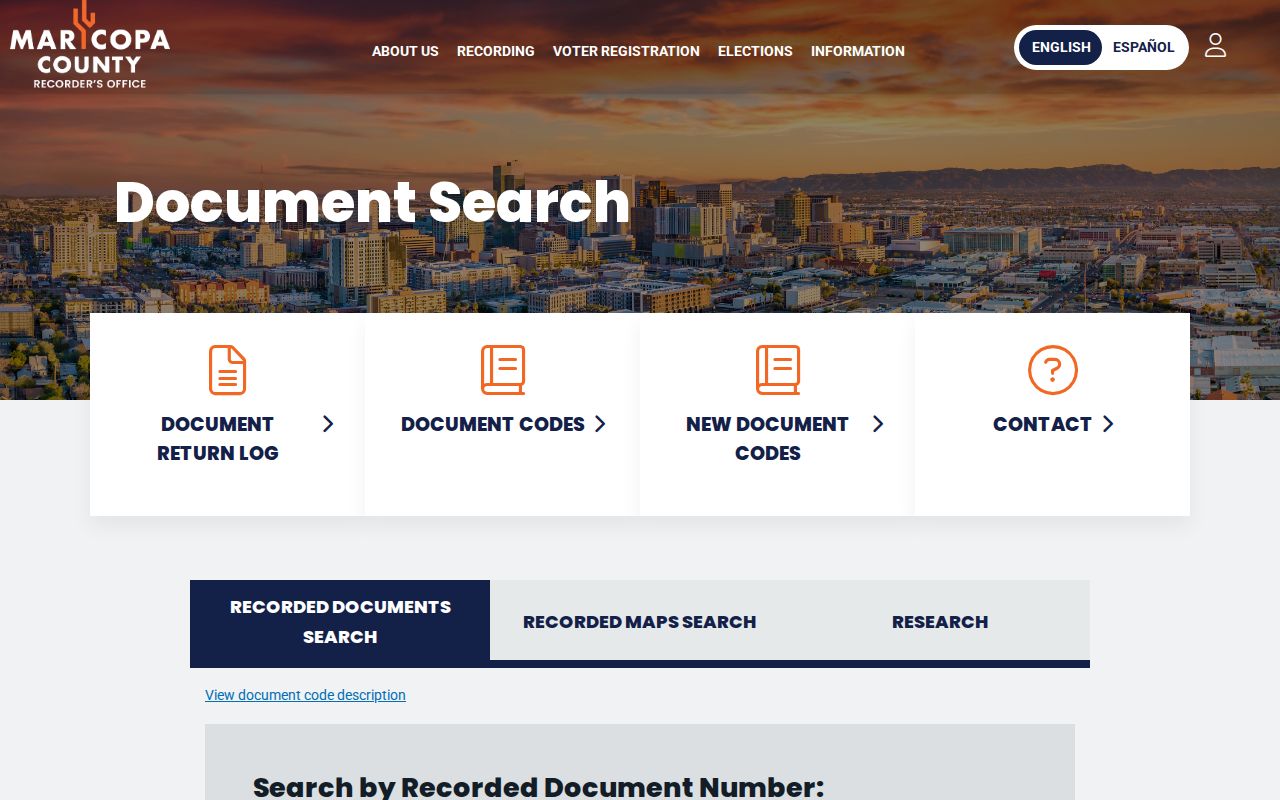
That mix is vital when a Fountain Hills parcel crosses older county systems.
Key limit: A Recorder name search is not a title report and cannot prove that no lien exists.
Fountain Hills Court Record Check
The Arizona Public Access Case Lookup can connect a name with a case number, court, filing date, type, and status. It updates weekly and is a finding aid, not the official file. Sealed cases, protective orders, mental-health matters, probate, victim and witness data, most juvenile records, and some Maricopa Superior Court material do not appear. Search name variants and narrow by date or court, then confirm the file with the creating clerk.
For Superior Court documents filed from July 1, 2010, eAccess provides a paid remote channel. The Maricopa clerk also supplies copy services. Fountain Hills Municipal Court accepts its request form by email, mail, in person, or drop box. The revised form states a 5 to 7 business-day estimate and warns that records purged under the judicial retention schedule cannot be produced.
The statewide case-search screen makes the verification and coverage warnings part of the search itself.
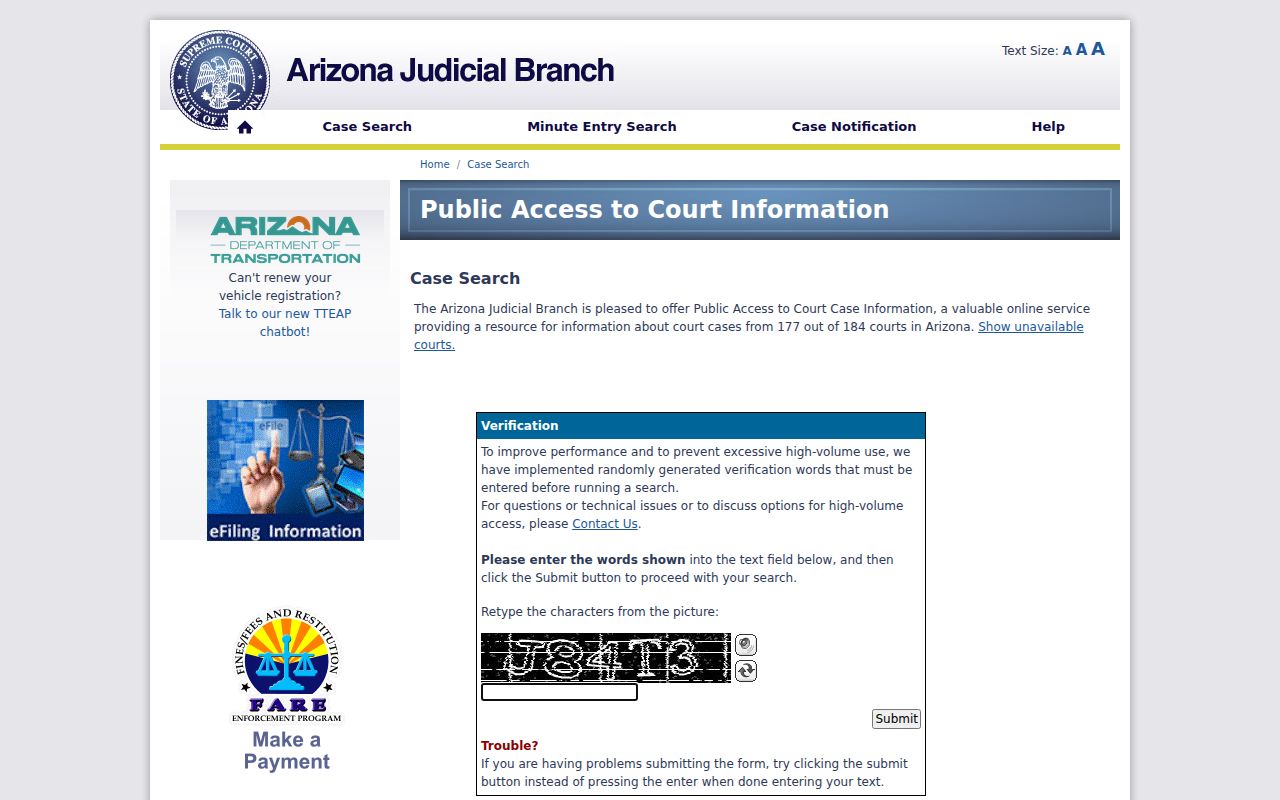
Save the case number and court before seeking an official copy.
Fountain Hills Voter Records
The Arizona Voter Information Portal is an identity-gated personal lookup, not an open street directory. Maricopa County voter files follow A.R.S. §16-168. A requester must use the information for a purpose the statute permits, and the file excludes voters protected under §16-153. Participation history may show that a voter took part in an election, never how that person voted.
County requests can be made through the Recorder's voter and election record forms. The current base fee is $93.75 through 124,999 records, with statutory per-record pricing beyond that point. In-person help and precise written requests remain important when a public interface cannot answer the question. Do not republish a purpose-limited file online.
The official Arizona voter portal illustrates why identity verification is part of access.
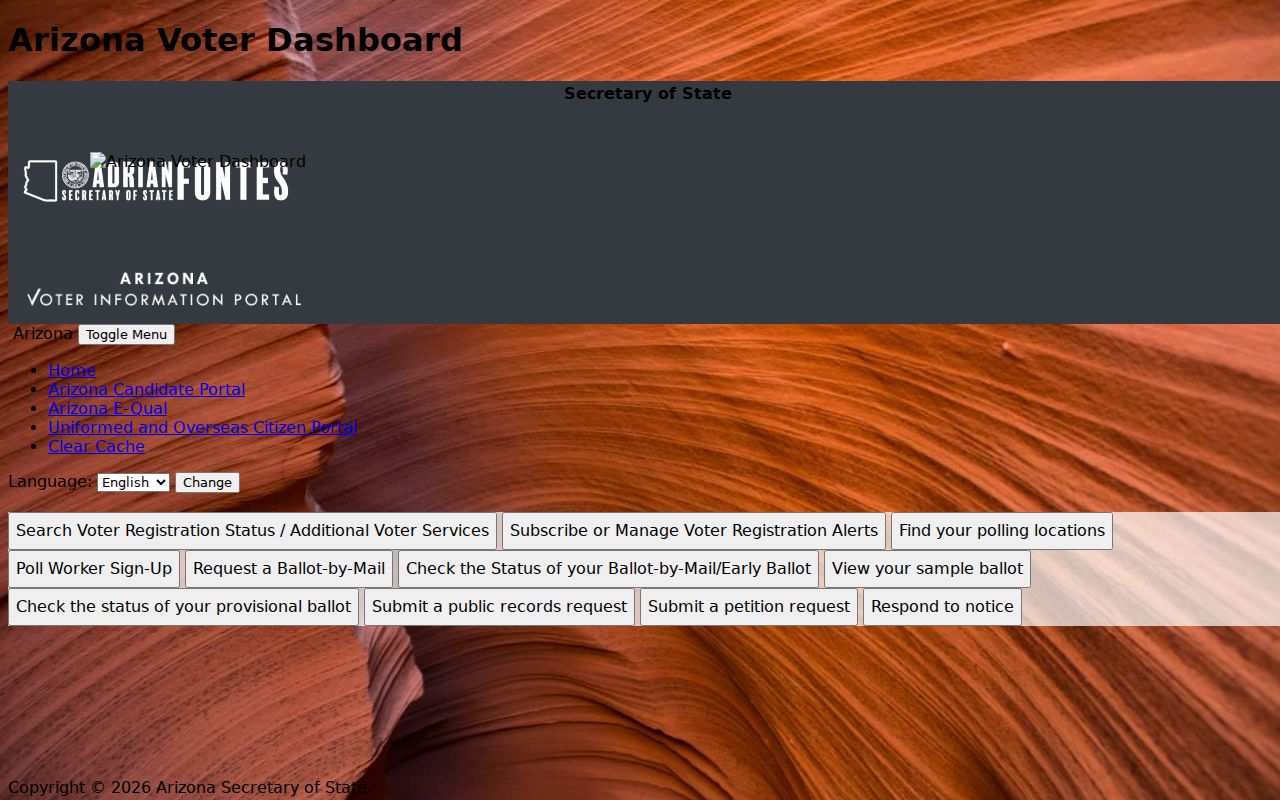
Protected addresses must stay protected across every later search.
Current Fountain Hills Directory Sources
No current source lists all Fountain Hills residents. The best directory is a comparison of dated, role-specific records. Use an official roll to answer one narrow question, then verify the match elsewhere. Commercial people-finding tools combine public and private feeds, can merge same-name people, and may charge for stale results. They are leads only and are never authoritative.
| Official roll | Commercial compilation |
|---|---|
| Created for a defined public duty | Aggregates many feeds under private methods |
| Shows a dated role and named custodian | May hide the source date or merge identities |
| Offers an office correction or copy route | Uses its own privacy and removal process |
The official sources differ from one another as well. Their coverage and access rules show why no single hit is enough.
| Source | Who It Lists | Keeper | Access |
|---|---|---|---|
| Property roll | Indexed owners and parcels | Maricopa County Assessor | Free portal |
| Voter records | Eligible registration fields | Recorder and Elections | Restricted by Arizona law |
| Recorded document index | Parties to deeds, liens, plats, and notices | Maricopa County Recorder | Free index; paid official copies |
| Town archive | Named officials, applicants, and public participants | Fountain Hills Town Clerk | Free archive and requests |
| Community sources | Published board, club, or business contacts | Each organization | Public or voluntary |
Choose by role. The assessor confirms indexed ownership, not every occupant. A deed confirms a transaction and named roles, not a move. Town minutes prove participation in a municipal event. An HOA, Chamber, club, congregation, or service group may publish official contacts, but no authoritative Fountain Hills umbrella household roster was found. The focused Fountain Hills resident lookup shows how to compare records for one name.
Fountain Hills Town Records
The Town Clerk is the local fallback for council minutes, ordinances, resolutions, proclamations, boards, commissions, contracts, election material, planning, permits, and code records. Town Hall is at 16705 E Avenue of the Fountains and is open Monday through Thursday, 7 a.m. to 6 p.m. The clerk's direct numbers are 480-816-5115 and 480-816-5107. General requests use the Town public-records portal.
The separate Archive Center searches by keyword, archive group, time period, and start or end dates. Its groups include Town Council, Planning and Zoning Commission, ordinances, resolutions, election results, public safety, preservation, and the Eagle Mountain Community Facilities District. Permit and code history may require a request by exact address, APN, record type, and date range because no stable public permit-search field list was verified.
The official Town request page shows where municipal records enter the Fountain Hills residents directory.
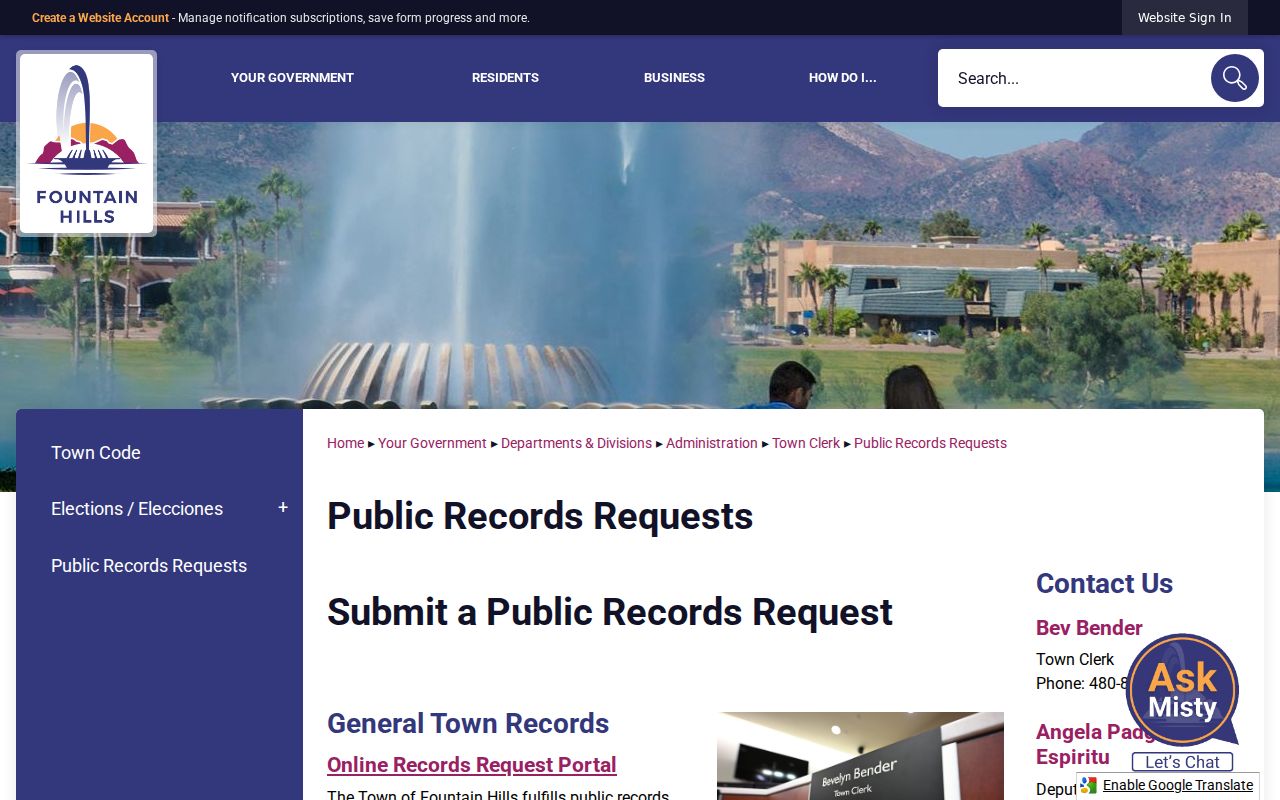
The request route matters most when a named series is not self-service online.
Fountain Hills Vital Records
Birth and death records open on different clocks. Under A.R.S. §36-351, Arizona birth certificates transfer to the State Archives 75 years after birth, while death certificates transfer 50 years after death. Newer certified copies require statutory eligibility, proof of identity, and the application channel used by the Maricopa County Office of Vital Registration or the Arizona Department of Health Services. Marriage licenses and divorce decrees are court records instead.
Current certificate rules are not a name directory. Use archival records for family history after the transfer period, and use certified channels only when eligibility exists. The current death-certificate application states a $20 fee and documents the identity and relationship checks.
The state vital-records office sets the current access path.
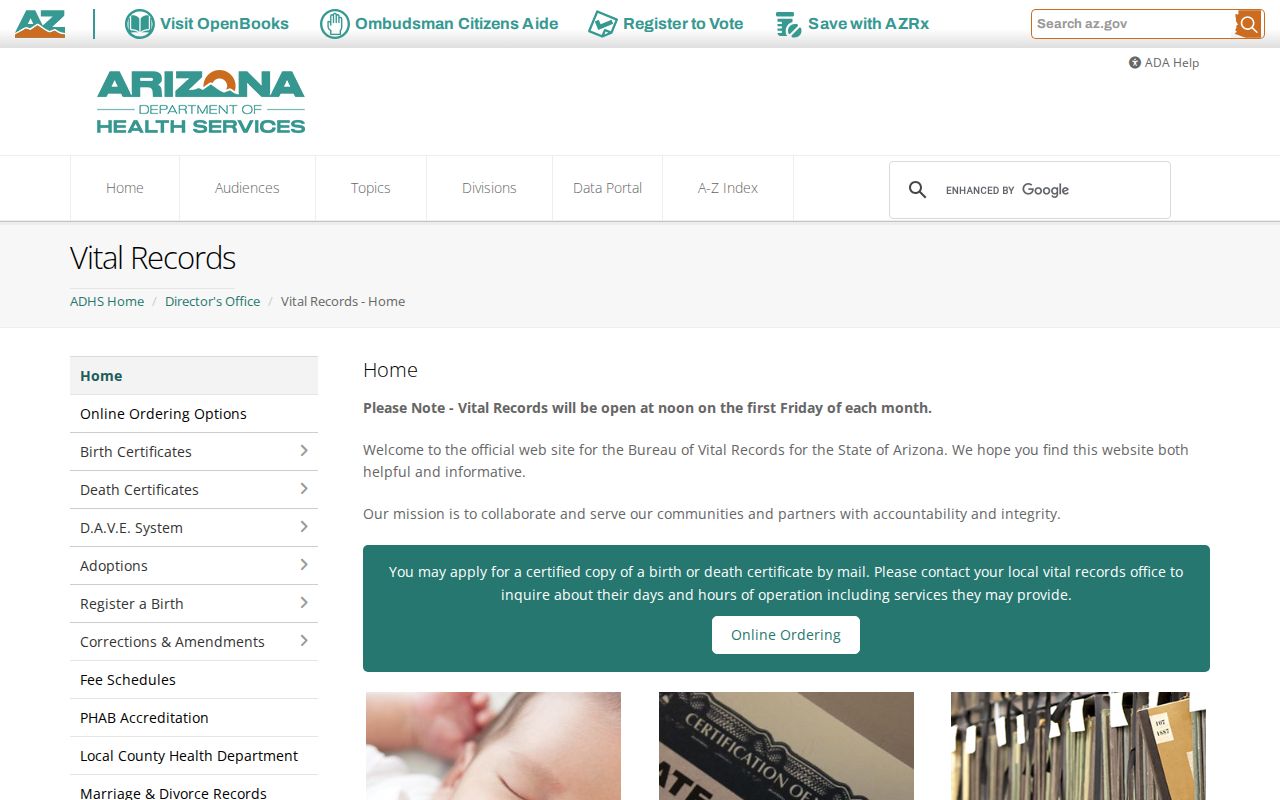
These limits prevent an open search from bypassing protected family records.
Fountain Hills Request Rules
Arizona Public Records Law, chiefly A.R.S. §§39-121 through 39-128, makes records in an officer's custody open for inspection by any person during office hours. Arizona uses a prompt-production standard, not one fixed statewide deadline. A request should name the record series, custodian, dates, party or parcel identifiers, and preferred format. Asking for “everything” about a person is slower and may not identify an existing series.
Arizona SB 1372, enacted in 2025, added an affirmation of noncommercial purpose or an explanation of commercial purpose to public-record intake. State the purpose accurately. A.R.S. §39-121.03 also governs commercial use, fees, and misuse damages. Inspection, email, mail, an online portal, and an office counter may yield different forms of the same public record.
The signed 2025 legislative summary documents the newer intake requirement.
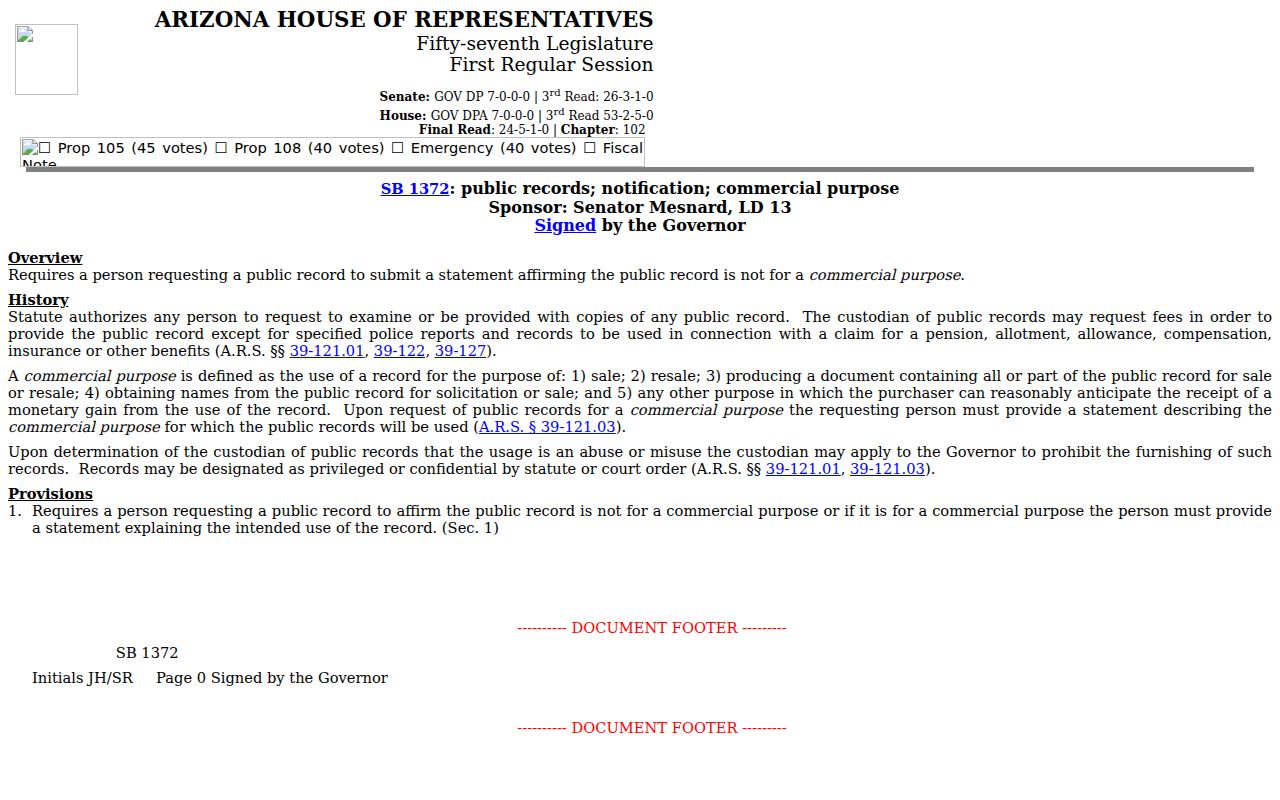
The change affects the request step without ending the basic right of inspection.
Fountain Hills Search Vocabulary
Record systems use terms that can change the meaning of a result. Define each field before treating a hit as a resident match.
- Roll
- A dated official list made for one purpose, such as taxation or registration.
- Index
- A finding aid that points to a document; it is not always the official record image.
- Parcel
- A unit of taxable land identified by an assessor parcel number, or APN.
- Criss-cross directory
- A printed directory arranged by address or phone number instead of surname.
- Certified copy
- A copy authenticated by the office that holds the original record.
Keep the date and source with every extracted fact. That small habit prevents a mailing address, case contact, or old directory entry from being presented as current occupancy.
Lawful use: Use Fountain Hills records for legitimate personal research, never to stalk, harass, threaten, or expose a protected person.
Fountain Hills Directory by Numbers
Official Census estimates explain why property and estate sources carry unusual weight in a Fountain Hills residents directory. The 2020 population was 23,820, while the July 1, 2025 estimate was 23,625. The town covers 20.28 square miles. For 2020 through 2024, Census figures list 11,031 households, 13,177 residential units, 2.13 people per household, and an 84.4 percent owner-occupied rate. Another 89.3 percent of residents had lived in the same house one year earlier.
Those numbers do not identify anyone. They help choose a search method. A high ownership rate makes the assessor and Recorder productive, yet neither can name renters or every person in an owner-occupied home. The town's 40.7 percent share of residents age 65 or older also makes probate, archival death records, obituaries, and estate deeds useful family-history trails. About 1,895 veterans strengthen the value of yearbooks, service groups, military reunions, and historical collections for lawful reconnection.
Never turn community statistics into a claim about one household. Median values, education levels, age shares, and business receipts describe Fountain Hills as a whole. A personal conclusion still needs a dated, named record and a second source that matches a strong identifier.
Historical Fountain Hills Directories
Fountain Hills has a young municipal archive inside a much older regional record system. The town incorporated on December 5, 1989, after planned development had already converted larger land descriptions into subdivisions, lots, and street addresses. No official source reviewed identified a standalone Fountain Hills directory run or a verified local reverse-directory shelf. Older searches must combine Maricopa County plats, deeds, assessments, planning records, Phoenix and Salt River Valley directories, newspapers, maps, and later development records.
The Arizona Memory Project offers nearly 400 city directories dated from 1881 through 1989, more than 120 newspaper titles, and nearly 600 yearbooks from 1903 through 1996. Search “Fountain Hills,” known subdivision names, and broader regional terms before applying place filters. The Fountain Hills Library can help reach county resources, while the State Research Library Reading Room and Arizona Historical Society hold broader print, microform, map, and directory material. The full collection method belongs on the Fountain Hills city directory page.