
Fountain Hills Directory Collections
There is no verified nineteenth-century or early twentieth-century Fountain Hills city directory run. The town incorporated on December 5, 1989, after its development as a planned community. Older research therefore moves outward to Phoenix, Salt River Valley, Maricopa County, and statewide collections. The Arizona Memory Project city-directory collection is the broadest online starting point. Its statewide set contains nearly 400 volumes, while the related “Places We Lived” group spans the 1880s through the 1960s.
The correct volume depends on how its publisher defined the region. A modern town name may not appear in the catalog record of a regional book. Search Fountain Hills, a subdivision name, Maricopa County, Phoenix Metropolitan Area, and Salt River Valley before deciding that a year is absent.
| Collection | Years represented | Where held | Access route |
|---|---|---|---|
| Arizona city directories | 1881-1989 statewide | Arizona Memory Project and partners | Free digital search |
| “Places We Lived” directories | 1880s-1960s | Arizona Memory Project | Free digital; more print years in Reading Room |
| Maricopa County subset | 120 catalog hits at research time | Partner collections | Filter by county, city, and year |
| Phoenix and Salt River Valley Directory | Verified 1926 example | Arizona Memory Project | Digitized PDF |
| Print, microform, maps, newspapers | Catalog-specific | State Research Library | Reading Room or remote request |
A missing year is not a known publication gap unless the catalog says so. No official source confirmed a Fountain Hills-titled Polk set, a local reverse shelf, or a city-specific publication end date. That documented limit protects family histories from false certainty.
Fountain Hills Joins Older Records
Maricopa County began in 1871, but Fountain Hills municipal records begin much later. Before incorporation, the most useful trail runs through county deeds, subdivision plats, planning files, tax and assessment rolls, election precincts, and township-range-section descriptions. After incorporation, Town ordinances, council minutes, planning cases, and permits add a local layer. The history is a handoff between record systems, not a lost shelf of old Fountain Hills city directories.
Fountain Hills geography changes name searches. A person connected to the future town site may appear under a regional heading, a ranch or development name, a subdivision, or a legal land description. Lakeside Village, Bainbridge, Golden Eagle, Eagle Mountain, Firerock, and SunRidge Canyon are useful place terms because catalog language and recorded plats do not always match the postal city line.
| 1871 | Maricopa County is created, establishing the older county record base. |
|---|---|
| Pre-1989 | County plats, land records, planning, and regional publications carry the trail. |
| December 5, 1989 | Fountain Hills incorporates and begins its municipal archive. |
| After incorporation | Town records join county property and court records without replacing them. |
Search Fountain Hills Directories Digitally
The Arizona Memory Project search can combine a keyword with an Item Type. “Within Data” choices include Title Only, All Fields, and All Fields plus Content. Search logic can require all keywords, accept any keyword, or look for an exact phrase. Date From and To fields and extra selectors can narrow a crowded result set. OCR, or machine-read text from scanned pages, makes names searchable but often misreads faint type and narrow columns.
Start broad. Search the surname, then the full name, town, subdivision, and regional phrases. If OCR returns nothing, browse the alphabetic pages. Before recording an entry, capture the volume title, original date, creator or publisher, contributing institution, collection, rights statement, stable item URL, and both printed and viewer page numbers. The printed page can differ from the PDF page.
The statewide scale is substantial: nearly 400 directories, more than 120 represented newspaper titles, and almost 600 yearbooks were documented during Fountain Hills research. Those numbers describe Arizona collections, not a Fountain Hills-only count. Each hit still needs its own locality and date check.
Decode a Fountain Hills Directory Entry
A city directory entry is compressed evidence. Depending on the edition, it may name a resident, spouse or family member, work, employer, address, widow or head-of-household status, and an owner or renter mark. Regional books may also contain street indexes, churches, societies, buildings, public services, business classes, advertisements, and short local histories. Never carry an abbreviation from one edition into another without checking that volume’s key.
| Printed name | Surname, given name, initials, and sometimes a spouse in parentheses. |
|---|---|
| Work detail | An occupation or employer as stated for that publication year. |
| Address | A house number and street, often shortened according to the edition key. |
| Household mark | Possible owner, renter, widow, or head-of-household notation when defined. |
| Page context | Nearby entries, street section, and classifications that help test identity. |
One Fountain Hills line does not prove a full household or a precise move date. It shows what the publisher printed for that edition. Keep the image, citation, and abbreviation page together so another researcher can reproduce the reading.
- Criss-cross directory
- A section arranged by street and house number rather than by surname, when a volume includes one.
- Householder index
- An address-led list of the person presented as responsible for a household.
- Abbreviation key
- The edition-specific list that explains shortened words and status marks used in entries.
Fountain Hills Library Starting Point
The Fountain Hills Library at 12901 N La Montana Drive is a practical local access point. It is open Monday through Wednesday from 9 a.m. to 7 p.m. and Thursday through Saturday from 9 a.m. to 5 p.m.; Sunday is closed. The phone number is 602-652-3000. Its official branch page does not claim a dedicated genealogy room, obituary index, or verified Fountain Hills reverse-directory run, so those holdings should not be assumed.
The library shares the Centennial Circle area with the River of Time Museum. That makes the pair useful for separate kinds of evidence: county library databases and staff help on one side, then local photographs, oral histories, and donor material that the museum may hold under its own policies. Contact the museum before relying on a named collection.
The branch page shows the setting and current library details. View the Fountain Hills Library source before planning a visit.
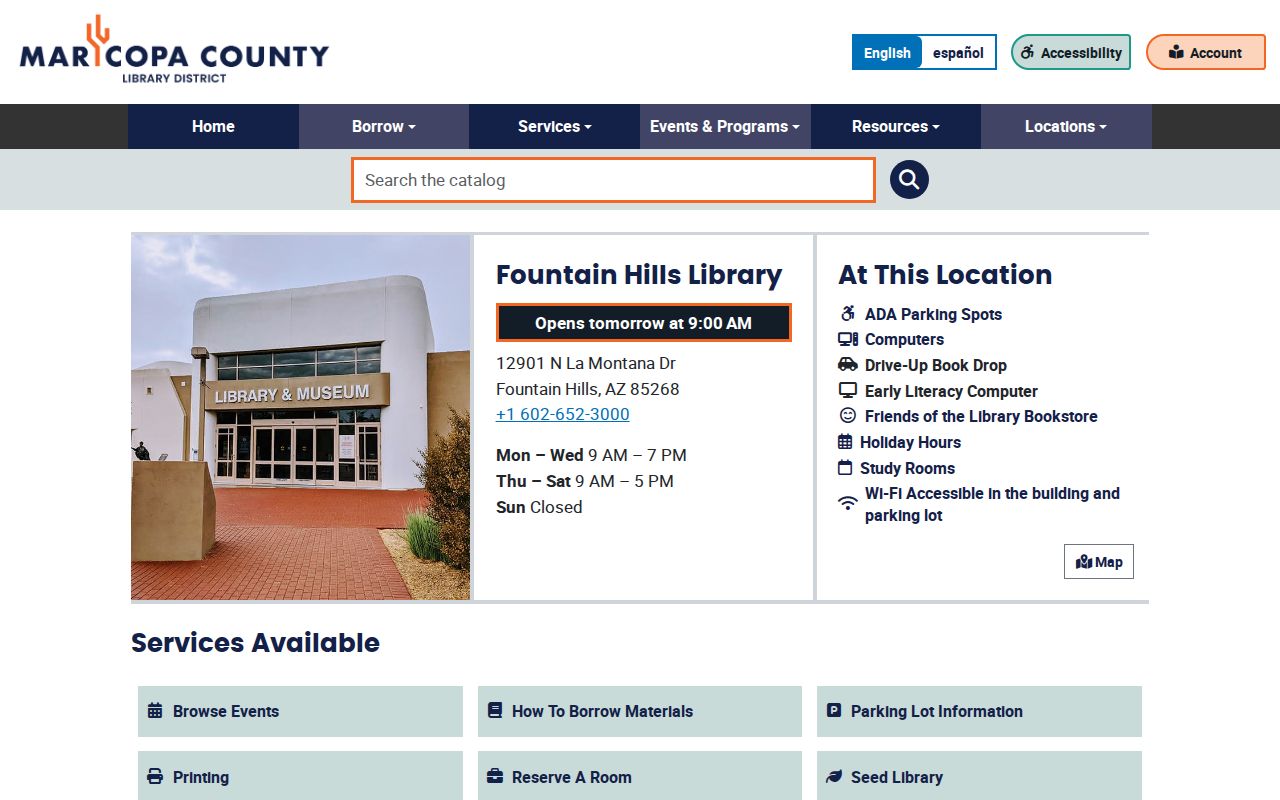
The captured branch page confirms a real local research stop while keeping the deeper historical directory claims with the statewide and regional custodians.
Arizona Reading Room Directory Shelf
The State Research Library at 1901 W Madison Street in Phoenix holds print and microform city directories, historic newspapers back to 1859, maps, vertical files, and selected genealogy materials. Listed Reading Room hours are 8 a.m. to 5 p.m. The policy also provides a remote newspaper and city-directory search route, an important access channel when a digital search fails or a needed print year is not online.
The Arizona Historical Society’s city and business directory collection supplies another regional shelf and accepts reference or reproduction questions at ahsreference@azhs.gov. Its holdings help with nineteenth-century residents and firms, but they do not establish a standalone Fountain Hills run. State Archives government series can add assessment, voter, court, land, and early marriage material when a directory clue points to a record group.
Note: Ask for a title, place term, surname, and narrow date range rather than requesting an open-ended search for every possible record.
Companions to Fountain Hills Directories
A thin city directory trail becomes stronger when other dated sources agree. The Arizona Memory genealogy guide points to newspapers represented from 1859 through 1989 and yearbooks from 1903 through 1996. Search an exact address, surname plus Fountain Hills, a subdivision, a business name, funeral notice, or legal notice. Always record the paper’s publication place and date because digital coverage is not universal.
Yearbooks can resolve an age, middle initial, photograph, club, or school connection. They do not prove a home address. The National Archives census guidance explains the 72-year release rule, with 1950 the latest public census at the time of the research. Early schedules require enumeration geography, nearby communities, or land descriptions because Fountain Hills did not yet exist as an incorporated town.
Sanborn maps are available through the State Research Library, but no Fountain Hills sheet or year was verified. Use a map only after confirming its coverage. For the modern address layer, the Fountain Hills street directory explains how parcel and deed records take over where the historical shelf ends.
Trace Fountain Hills Families by Year
Family history works best as a dated evidence grid. Keep the exact printed name, spouse or household notation, work, street number, owner or renter mark, printed page, viewer page, and confidence level for each year. Then compare only like facts. A one-year absence is a gap, not proof that someone moved or died.
- Choose the correct regional volume and record its title, year, publisher, and geographic scope.
- Search surname variants, initials, former names, and OCR errors, then browse alphabetically if needed.
- Copy the full printed line and consult the same volume’s abbreviation key.
- Repeat in adjacent years and use the street index or reverse section only when the volume includes one.
- Pair 1940 or 1950 directory evidence with the released census, then test later addresses through parcels, deeds, newspapers, and probate.
A disappearance can reflect omission, seasonal residence, a changed surname, coverage outside the publisher’s area, a new address, or death. Newspapers, probate files, archival death certificates, and deeds can distinguish those paths. The method is slower than copying a single search result, but it produces a defensible Fountain Hills city directory history.
Fountain Hills Directory Gaps Matter
Historical directories are not full resident rolls. They may omit children, people who declined listing, short-term residents, and households outside the publisher’s territory. A street section may be absent. A name can be misspelled or condensed. Later Fountain Hills addresses may have no direct match to pre-development land, which may appear only through subdivision, lot, block, MCR map, or township-range-section.
Keep each claim at the level the source supports. A yearbook is school evidence. A directory line is a published association with an address. A deed names parties to an instrument, not every occupant. A census lists a household on its enumeration date. When those sources align, the combined history is useful without pretending any one of them is complete.